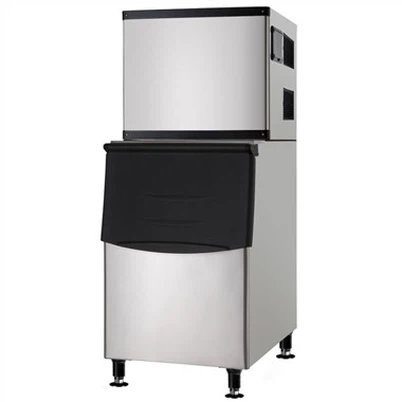
The Composition Of The Evaporator Of The Flake Ice Machine
Leave a message
The composition of the evaporator of the flake ice machine
The evaporator of the ice machine is driven by the ice blade, sprinkler tray, main shaft, and water tray, and is slowly rotated counterclockwise under the drive of the reducer. Water enters the water distribution tray from the water inlet of the ice machine evaporator, and through the sprinkler pipe, the water is evenly sprinkled on the icing surface to form a water film; the water film exchanges heat with the refrigerant in the refrigerant flow channel, and the temperature drops rapidly , A thin layer of ice is formed on the icing surface, and under the extrusion of the skates, it breaks into flakes of ice and falls into the ice storage from the ice outlet. Part of the unfrozen water returns to the cold water tank from the water return port through the water receiving tray, and circulates through the cold water circulation pump.
Flake ice machines have been widely used in aquatic products, food, supermarkets, dairy products, medicine, chemistry, vegetable preservation and transportation, marine fishing and other industries. With the development of society and the continuous improvement of people's production levels, the industries using ice are becoming more and more extensive. The quality requirements for ice are getting higher and higher. The requirements for "high performance", "low failure rate" and "hygiene" of ice machines are becoming more and more urgent.
The evaporator of the flake ice machine is a very important part of the four major components of refrigeration, and it is also a partitioned heat exchange device. The low-temperature condensed "liquid" body passes through the evaporator to exchange heat with the outside air, and "gas" absorbs heat to achieve the effect of refrigeration. According to the operating pressure, the evaporator is divided into three types: normal pressure, pressurized and decompressed.
Evaporation is a unit operation that uses heating to heat a solution containing a non-volatile solute to a boiling state, so that part of the solvent is vaporized and removed, thereby increasing the concentration of the solute in the solvent. The application of evaporation operation in industrial production has the following occasions:
1. Concentrate dilute solutions to directly produce products or reprocess concentrated solutions (such as cooling and crystallization) to produce solid products, such as the concentration of electrolytic caustic soda, the concentration of sugar aqueous solution and the concentration of various fruit juices, etc.
2. Concentrate the solution and recover the solvent at the same time, such as the concentrated debenzene of organophosphorus pesticide benzene solution, the evaporation of alcohol leachate in the production of traditional Chinese medicine, etc.
3. In order to obtain pure solvents, such as seawater desalination, etc.
In short, in the chemical industry, food industry, pharmaceutical and other industries, evaporation operation is widely used.